Tanks, leaks and the environmental report
What buyers and lenders check on the tanks under a C-store, how a Phase I and Phase II work, and how state cleanup funds fit in.
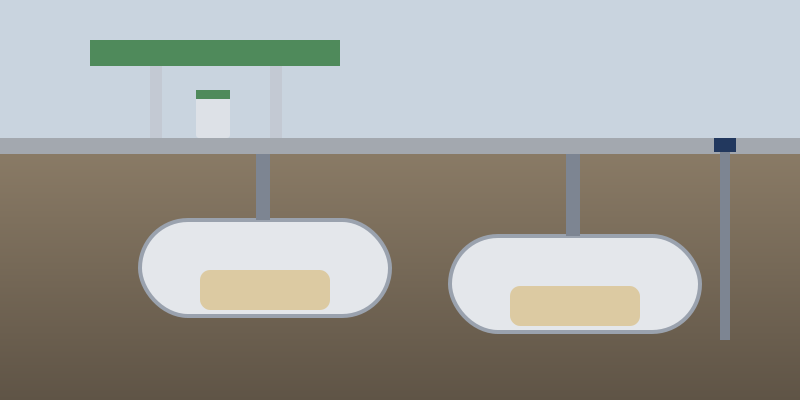
Every buyer, lender and insurer looking at a C-store ends up asking the same handful of questions about what is buried under the forecourt. Sellers who can answer them with paper close faster and argue less about price. Buyers who know which questions to ask avoid inheriting someone else's cleanup. Here they are, in the order they usually come up.
How common are tanks, and how common are leaks?
Very common, on both counts. EPA's UST Performance Measures count 534,189 active federally regulated underground storage tanks at about 190,224 facilities as of March 2026. EPA's own UST home page rounds that to about 542,000 tanks, without saying what date the figure is from, so call it somewhere north of half a million.
The same EPA performance report counts 583,313 confirmed releases since the program started in 1984, with 530,454 cleaned up and 52,859 still open as of March 2026. Read that plainly: most old leaks have been closed, but tens of thousands have not, and a closed file is still something a buyer's consultant will want to read. A past release is not a dealbreaker. An undocumented one usually is.
What is actually down there?
At a typical station you are looking at two to four tanks, the piping that runs from them to the dispensers, the sumps under the dispensers and at the tank tops, the spill buckets where the transport driver connects, overfill prevention, and the release detection system that watches all of it. Some tanks are single-wall steel from decades ago. Newer ones are double-walled with a monitored space between the walls.
Age and construction matter because the rules changed. EPA's 2015 UST rule, published July 15, 2015 and effective Oct. 13, 2015, added operator training, secondary containment for new and replaced tanks and piping, and periodic walkthrough inspections and equipment testing, with compliance deadlines running to Oct. 13, 2018. A site whose tanks predate that rule is not automatically a problem, but the buyer will want proof it caught up.
Which records prove the system is maintained?
This is where most deals slow down. A buyer's consultant and the lender will ask for:
- Release detection records. Under EPA's rules (summarized in its "Musts for USTs" guide, Nov. 2015), tanks need monthly monitoring, not to exceed 30 days, by a method such as automatic tank gauging or interstitial monitoring, plus annual operability tests of the detection equipment.
- Spill bucket tests and overfill equipment inspections. EPA's same guide calls for both every three years under the 2015 rule.
- Walkthrough inspection logs and operator training certificates.
- Line and leak detector tests, cathodic protection tests where the tanks rely on it, and repair invoices.
- Registration with the state. In Texas, the Texas Commission on Environmental Quality (TCEQ) regulates petroleum storage tanks under 30 TAC Chapter 334. Per TCEQ (page last modified Oct. 21, 2026), regulated tanks must be registered, and motor fuel tanks must be self-certified every year to receive a delivery certificate. No current certificate, no legal fuel drops.
- Proof of financial responsibility, covered below.
If you are selling, put these in one folder now. Our guide to getting a C-store ready to sell covers the rest of that folder.
What happens if something leaks?
EPA's frequently asked questions (updated June 3, 2026) say a suspected release must be reported to the state or local implementing agency within 24 hours, or within whatever period that agency sets. From there the state oversees investigation and cleanup, and the owner or operator pays for it, directly or through a fund or policy.
A buyer cares about two things here: is there an open release on the site today, and if there was one in the past, was it closed with a letter from the regulator? A "no further action" letter or its state equivalent is worth more in a closing binder than any verbal assurance.
Who pays for cleanup: state funds and insurance
Tank owners must show they can pay. EPA's "Musts for USTs" guide sets the federal floor: petroleum marketers, or anyone handling more than 10,000 gallons a month, need $1 million per occurrence, and $1 million aggregate with 100 or fewer tanks or $2 million with more than 100.
Owners meet that with a state fund, private insurance or a mix. EPA's State Financial Assurance Funds page (dated Apr. 29, 2026) says 36 states have state funds, six more have funds that cover only older releases, and eight states plus D.C. and five territories rely on private coverage. Whether a given state's fund will pay for a new release at a given site, and how much the owner pays first, varies. We have not confirmed whether Texas still runs an active fund for new releases, so do not assume one; ask the regulator and your consultant.
Private tank liability policies and broader pollution legal liability policies are the other route. For a buyer, the question is whether coverage for past conditions is available at all, and at what cost and deductible. That answer often shapes the deal more than the Phase I does.
How does a Phase I work, and when does a Phase II follow?
A Phase I Environmental Site Assessment is a records review, site visit and interviews. No digging. EPA recognizes ASTM E1527-21 as meeting its All Appropriate Inquiries rule (EPA Brownfields AAI page, updated May 7, 2026). Doing AAI properly is what lets a buyer claim certain defenses against cleanup liability later, so it is not paperwork for its own sake.
Timing matters. Per that EPA page, AAI must be done or updated within one year before you acquire the property, and certain parts (interviews, the lien search, the government records review, the site visit and the environmental professional's declaration) within 180 days. ASTM E1527-21 likewise presumes a Phase I is viable when done within 180 days before acquisition. A report ordered too early in a slow deal can go stale before closing.
On an operating fuel site, the Phase I will almost always flag the tanks themselves as a recognized environmental condition. That often leads to a Phase II: soil borings and groundwater samples near the tanks, lines and dispensers, sometimes with tank and line tightness tests. A Phase II costs more and takes longer, and its results are what move price.
How does all this show up in price and loan terms?
Clean records, newer double-walled equipment and a closed release file mostly do one thing: they keep the buyer pool wide and the timeline short. They rarely add to the price on their own.
Problems show up in four ways:
- Price. A buyer prices in tank replacement or cleanup they think is coming, usually with a cushion. See how buyers price a C-store.
- Structure. Escrow holdbacks, seller indemnities, or a seller agreeing to finish a cleanup after closing.
- Financing. Lenders set their own environmental standards. A lender may require a Phase II, a clean result, or proof of coverage before it will close. See SBA loans for C-store buyers and Finance.
- Buyer pool. Net lease investors and institutional buyers are less tolerant of open environmental issues than operators who know fuel. That matters if you plan a sale lease back.
What we do with it
On a sale, we gather the tank file before we market the store, so the first buyer question has an answer the same day. On a purchase, we push for the Phase I to start early enough to leave room for a Phase II without blowing the closing date. If you want to talk through a specific site, start at Sell or Buy.
None of this is environmental or legal advice. Before you sign, hire an environmental consultant to read the site and the records, and have an attorney review how the contract assigns the risk.